

- About
- Programs
- View all programs
- Swiss Professional Bachelor - Advanced Federal Diploma in Business Administration

- Bachelor of Business Administration (BBA)

- Bilingual BBA French-English

- Bilingual BBA Chinese-English

- Bachelor of Arts (Honours) in International Business Management & Global Affairs

- Executive Post-Diploma in Applied AI & Customer Experience

- Master in Applied AI in Customer Experience

- Additional Programs
- Business Immersion
- Student Life
- Career Services
- Admissions
- News & Events
- Alumni




















Digital Strategy: Definition, Trends, and How to Build One
Learn what digital strategy means, how it differs from digital transformation, and which technology trends, from AI to data, are shaping business in 2026.

Key takeaways
- A digital strategy is a company's plan for using technology and data across its channels to reach specific business goals.
- Digital strategy sets the direction, whereas digital transformation is the change in how the business operates that follows from it.
- Five technology trends shaping business strategy include: AI and automation, data and personalization, social commerce, cybersecurity and digital trust, and the changing skills inside the workforce.
- The scarce profile is the person who can connect technology to business decisions, which is what our Bachelor of Business Administration and our Master in Applied AI in Customer Experience are built to produce.
Companies are making more decisions with a digital dimension than they were even a few years ago. Customer expectations, new technologies, data, and changing ways of working increasingly influence decisions across the business, rather than sitting within one department.
That creates a different challenge for leaders: making sure those digital decisions add up to something coherent. This is why having a clear digital strategy has become increasingly important.
What is digital strategy?
A digital strategy is an organization's plan for using digital technology and data across the channels where its customers already are to achieve specific business goals such as reaching new buyers or lowering the cost to serve existing ones. It answers where to play and how to win before any tool is bought.
A digital strategy usually contains:
- Clear business goals and the digital opportunities that serve them.
- A picture of the target customer and how they behave online.
- Decisions about technology and data, including which options to skip.
- The people and ways of working needed to carry it out.
- Metrics that show whether it's working.
Digital marketing is one slice of this. It covers promotion through digital channels, while a digital strategy also reaches into operations, products, service, and the teams running them.
Digital strategy vs digital transformation
The strategy is the plan. The transformation is the change that plan sets in motion. It's important to distinguish between the two and remember that:
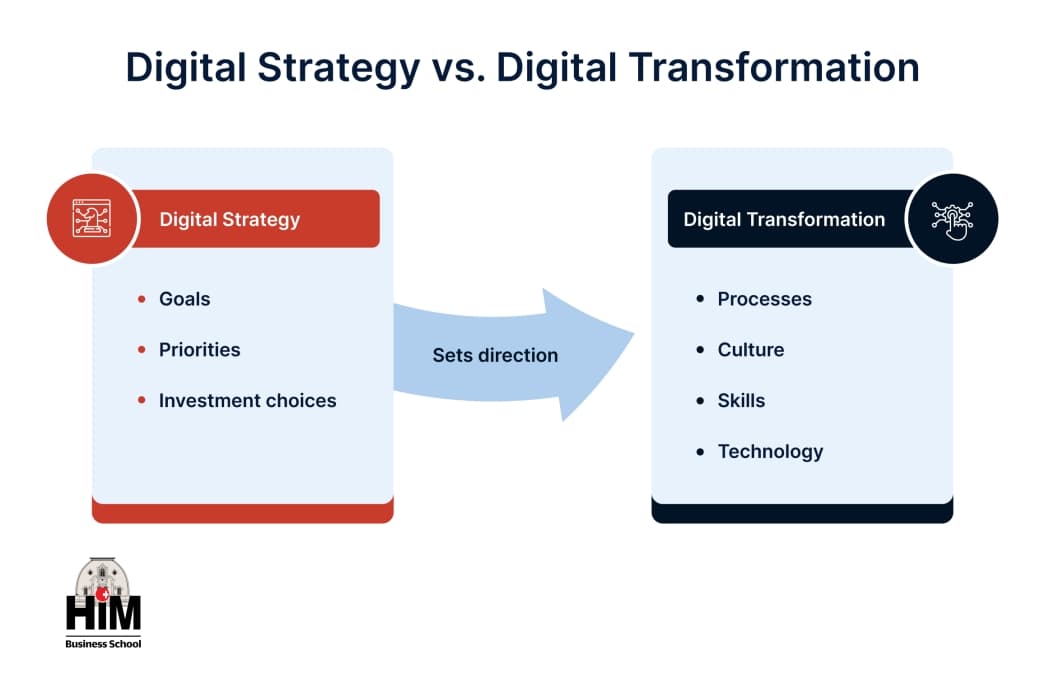
- Digital strategy means direction and choices: which goals, which priorities, which investments get funded.
- Digital transformation means execution and change: processes, culture, skills, technology.
- A company can have a strategy without transforming, through small focused plays such as moving one service online.
Transformation without a strategy is how budgets disappear. Systems get replaced, staff learn new tools, and afterward nobody can point to the business result that improved.
Five technology trends shaping business strategy
Five forces set the agenda that a digital strategy has to answer. Each one forces a choice rather than a purchase, and those choices are where one company's plan starts to differ from another's.
AI and automation in every function
Adoption is no longer the interesting part. In McKinsey's 2026 State of AI survey, 80% of respondents said AI had improved their own productivity, while only 37% could attribute any EBIT impact to it, unchanged from the year before. That lack of profit is a strategy problem rather than a technology problem: employees can adopt AI tools individually, but creating value across an entire function usually requires redesigned processes and clear ownership of the outcome. The harder decision is where to focus that effort. Rebuilding one or two high-value workflows end to end will usually produce more value than adding a dozen AI assistants to existing ways of working, which is what understanding AI in business looks like in practice.
Data, analytics, and personalization

Customer data now drives pricing decisions and product development, and personalization has become the baseline that customers expect. Netflix's research team published estimates in 2026 of what its recommender is worth: replacing it with popularity-based suggestions would cut engagement by 12%, and with random suggestions by 16%. Most companies do not have Netflix's volume of customer data, nor do they need it. The more useful question is which customer data actually improves a business decision and which data is being collected simply because it is available. Turning the answer into loyalty is the work of customer experience management.
Social commerce and the creator economy
Finding products has moved into short-form video and social platforms, and the buying now happens there too. Estimates of the market's size vary widely by methodology: Statista puts worldwide social commerce revenue near $586 billion in 2026, while several market research firms put it above $2 trillion. Brands increasingly treat creators as a sales channel with measurable conversion rather than as advertising spend. The strategic question is selection: which platforms earn a place in the plan, and which are noise for your particular customers. Watching marketing trends helps, as long as the answer stays anchored to where your buyers actually spend their attention.
Cybersecurity and digital trust
Every digital ambition creates a new risk to surface. IBM's 2026 Cost of a Data Breach Report put the global average cost of a breach at a record $4.99 million, up 12% year over year, with detection costs and lost business among the largest drivers. Rules such as the EU's GDPR raise the stakes further in any market where you hold customer data. The strategic takeaway is about ownership: security and privacy belong on the board agenda next to growth targets, because a breach takes revenue and customer trust at the same time.
New skills and ways of working
Technology pays off when people can use it. The World Economic Forum's Future of Jobs Report 2025 found that employers expect 39% of workers' core skills to change by 2030. Hybrid teams and cross-cultural work are ordinary conditions now, and continuous learning belongs inside the strategy rather than in a separate HR plan. The choice is about capability: which skills to build inside the team, and which work to hand to partners. Plans that assume a current team will absorb new systems without protected time to learn them tend to stall in month three.
How to build a digital strategy in five steps
To build a digital strategy, the goal is to move from broad digital ambition to a focused set of decisions that support the business. The process involves five steps:
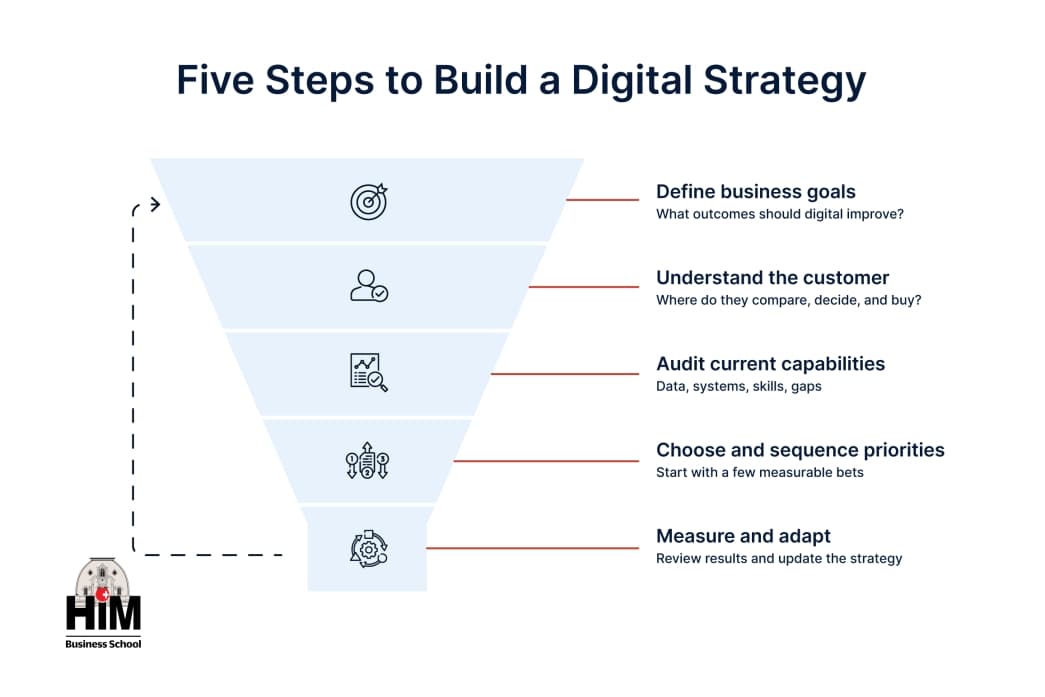
- Start with business goals rather than tools: Name the outcomes digital should move, whether that's revenue, cost, or the experience customers get. Two outcomes stated precisely beat ten listed loosely.
- Know the customer's digital reality: Map where they compare options and where they actually buy, which are frequently different places from where you advertise.
- Audit what exists: Take stock of the data you hold, the systems running, the skills in the team, and the gaps between them.
- Choose a few bets and sequence them: Small pilots with a measurable result come before company-wide rollouts, and the order matters, because early wins pay for later work.
- Measure, learn, and revisit: A digital strategy gets reviewed at least yearly, and sooner when one of its assumptions breaks.
Most digital plans stall for reasons that have little to do with technology: budget limits, systems too old to connect to anything, and employees handed new tools without being consulted. Steps three and four carry more weight than the tool selection for precisely that reason.
If you've been handed digital responsibility without a plan, which happens often in smaller companies, the sensible first move is writing down the business outcomes your leadership cares about and testing every proposal against them.
Digital strategy skills and careers
Every trend above creates demand for the same profile: someone fluent enough in technology to see what's possible and grounded enough in business to judge what's worth doing. That person also has to carry colleagues with them, since most of the work is persuasion and sequencing rather than configuration.
The roles this opens are already well established. Digital strategist, digital marketing manager, business analyst, digital transformation consultant, and AI product manager all sit on this ground, and AI-literate managers are being asked for in functions that have nothing to do with IT. At the senior end, some organizations have created a chief AI officer to hold the whole portfolio together.
Our three-year Bachelor of Business Administration builds this from Year 1, where Introduction to Data-Driven Decision-Making sits among the foundation courses. Innovating with AI follows in the Year 2 core, and Strategic Planning in Year 3, so the technology is taught inside business decisions rather than alongside them. For readers who already hold a bachelor's degree, our Master in Applied AI for Customer-led Business Transformation takes the same combination further at graduate level. Our World Readiness Index keeps the curriculum matched to changes in the job market, on a campus where more than 50 nationalities make cross-cultural work an everyday condition rather than a later adjustment.
Turn technology fluency into a career
A digital strategy is the plan that connects technology to business goals, and the five forces above are what any serious plan has to answer. The scarce ingredient throughout is people who can hold both halves of the conversation: what the technology can do, and what the business actually needs from it.
If that's the work you want, explore our BBA program page and look at how the courses build toward it. That combination is what Be World Ready means in a business world shaped by technology.
Frequently asked questions
What does a digital strategist do?
They translate business goals into a plan for technology and channels, usually working across marketing, IT, operations, and finance rather than inside any one of them. A large part of the job is prioritization: deciding which projects get funded this year and which wait.
What is an example of a digital strategy?
A retailer moves its loyalty program into an app so it can use purchase history to shape offers, and judges the project by repeat purchase rate rather than by downloads. The technology choice follows the goal, which is what makes it a strategy.
How often should a company update its digital strategy?
A yearly review is standard, with a quarterly check on the numbers the plan is judged by. Anything that breaks a core assumption, such as a platform changing its commercial rules, justifies an earlier rewrite.
What are the four pillars of digital strategy?
Consultancies name them differently, though most versions cover customers, operations, technology and data, and people. Treat any four-pillar model as a checklist for finding gaps rather than as a fixed framework.
Do you want to become world-ready? Learn how HIM Business School can help you.