

- About
- Programs
- View all programs
- Swiss Professional Bachelor - Advanced Federal Diploma in Business Administration

- Bachelor of Business Administration (BBA)

- Bilingual BBA French-English

- Bilingual BBA Chinese-English

- Bachelor of Arts (Honours) in International Business Management & Global Affairs

- Executive Post-Diploma in Applied AI & Customer Experience

- Master in Applied AI in Customer Experience

- Additional Programs
- Business Immersion
- Student Life
- Career Services
- Admissions
- News & Events
- Alumni




















What Is an Auditor? Role, Skills, and Career Path
Learn what an auditor does, the types of auditors, the skills and certifications required, and how to build an audit career after a business degree.

Key Takeaways
- Auditors independently examine an organization's financial records and internal controls, then report an objective opinion that investors, lenders, and regulators rely on.
- The work is client-facing as much as it is technical. Audits run on interviews, evidence requests, and difficult conversations, so communication carries as much weight as accounting knowledge.
- Entry follows a clear sequence: a business degree with accounting and finance foundations, early practical experience, then a professional qualification such as the CPA, the ACCA, or the CIA.
- Our three-year Bachelor of Business Administration at HIM builds that foundation and adds three worldwide internships, so students graduate with 1.5 years of professional experience.
Financial decisions depend on information people can trust. Companies, investors, regulators, and other stakeholders rely on financial records to understand how an organization is performing, how resources are being used, and whether reported information reflects what is actually happening.
That makes independent scrutiny an important part of the financial system. Auditors work in this space.
What is an auditor?
An auditor is an independent professional who examines an organization's financial records and internal systems to confirm they are accurate and comply with the applicable rules, then reports an objective opinion on what was found.
Every auditor is trained in accounting, and the two roles work in opposite directions. Accountants prepare and manage the records. Auditors check those records from outside the process, and that independence is the point of the job. An opinion signed by someone with a stake in the result carries no weight with the people reading it.
Shareholders, lenders, regulators, and employees all act on that opinion, which makes auditing one of the most regulated roles in business.
What does an auditor do?

An audit is a structured project rather than a spot check. The work runs in a set sequence, planning first, then testing, then reporting, with each stage documented closely enough that another auditor could follow the reasoning.
- Plan the audit: Set the scope and the deadlines, and identify the areas carrying the highest risk of error or fraud.
- Examine the financial statements: Check the balance sheet, the income statement, the cash flow statement, and the accompanying notes against the underlying records.
- Test internal controls: See whether the company's own systems catch mistakes before they reach the accounts, for example, whether a large payment requires a second approval.
- Assess risk and look for fraud: Flag errors and any sign of deliberate manipulation, and follow up on transactions that sit outside the normal pattern.
- Check compliance: Confirm the accounts follow the relevant accounting standards along with the tax and regulatory rules in each country where the company operates.
- Report the findings: Write the audit opinion and tell management what needs correcting and how.
Risk assessment has taken an increasing share of audit hours as standards push more effort toward the areas where misstatement is likeliest, which puts auditors close to the work of risk management teams inside their clients.
Types of auditors
Auditor is an umbrella title. The employer changes what the job looks like day to day, and the six categories below cover most of the roles a graduate will see advertised.
Type | Who they work for | What they focus on |
Internal auditor | One organization, as an employee | Improving that company's controls, efficiency, and risk management from the inside |
External auditor | An independent audit firm, including the Big 4 | Giving an independent opinion on clients' financial statements for investors and regulators |
Government auditor | Public sector bodies and agencies | Checking that public money is collected, spent, and reported correctly |
Forensic auditor | Firms, law enforcement, and legal teams | Investigating suspected fraud and financial crime, often for court proceedings |
IT auditor | Audit firms or in-house technology teams | Auditing information systems, cybersecurity, and data integrity |
Compliance auditor | Regulated companies and regulators | Testing adherence to specific regulation, including financial services rules and ESG reporting |
The choice early-career readers actually face is internal or external. External audit at a firm means many clients in a short space of time, faster technical learning, and a CV that travels. Internal audit means deeper knowledge of one business, closer contact with its management, and steadier hours. The two are different first chapters rather than better and worse options, and auditors move between them throughout their careers.
How to become an auditor
Entry into audit follows a predictable sequence, and taking the steps in order is what shortens the path.
- Earn a business degree with accounting and finance foundations: Employers screen for accounting principles, financial and managerial accounting, financial management, business law, and data analysis. Among BBA majors, finance-oriented tracks line up most closely with audit recruitment.
- Get practical experience early: Internships in audit firms or corporate finance departments are what convert into graduate scheme offers, and many firms recruit their intake from people they have already worked alongside.
- Start as a junior or staff auditor: The first two to three years go into testing and documentation under a senior's review, with client contact increasing as you prove reliable.
- Add a professional qualification: The CPA is the license for practicing in the United States. The ACCA and national chartered qualifications are used across Europe and internationally. The CIA covers internal audit, and the CISA covers IT audit.
- Progress or pivot: Senior auditor, audit manager, then director or partner, with a move into finance leadership open at several points along the way.
Requirements differ by country, and they are changing. The traditional US route runs through 150 semester hours plus a year of experience, while NASBA's updated model law adds a pathway of a 120-hour bachelor's degree plus two years of experience, which states are adopting one at a time. ACCA membership requires up to 13 exams alongside 36 months of supervised experience. Check the rules with the board or body where you intend to qualify.
Our three-year Bachelor of Business Administration is awarded by Northwood University (US); Northwood University programs are accredited through ACBSP. Students choose a major in Year 2, and Finance runs across Years 2 and 3. Three worldwide paid internships (4–6 months each) add up to 1.5 years of professional experience before graduation, and our career services coaches work one-on-one with students on CVs and interview preparation while they search for those placements. The degree builds the foundation. The audit qualification comes afterward, through the professional body in the country where you plan to practice.
Skills every auditor needs
Audit rewards technical precision and interpersonal judgment in equal measure, because auditors spend as much time asking questions as checking numbers.
Technical capabilities
Some of the core technical skills that every auditor needs include:
- Financial statement analysis and knowledge of accounting standards, covering IFRS or US GAAP.
- Internal controls testing and sampling methodology.
- Risk assessment and familiarity with fraud indicators.
- Data analytics and audit software, including the AI-assisted testing tools now applied to large samples.
- Documentation discipline, since an audit conclusion holds only as well as its evidence trail.
Interpersonal and cognitive skills
Technical work carries a junior auditor through the first two years. After that, promotion depends on client handling, which is why interpersonal skills are crucial too, particularly the following:
- Professional skepticism, meaning conclusions follow the evidence rather than the explanation offered.
- Integrity and independence, because an opinion holds value only when it cannot be influenced.
- Communication, since findings have to be explained to people outside the financial area too.
- Cross-cultural fluency, which decides how a finding lands when the audit team and the client sit in different countries.
- Time management, because audits run to hard reporting deadlines.
Pros and cons of being an auditor
Among the most attractive aspects of this job are:
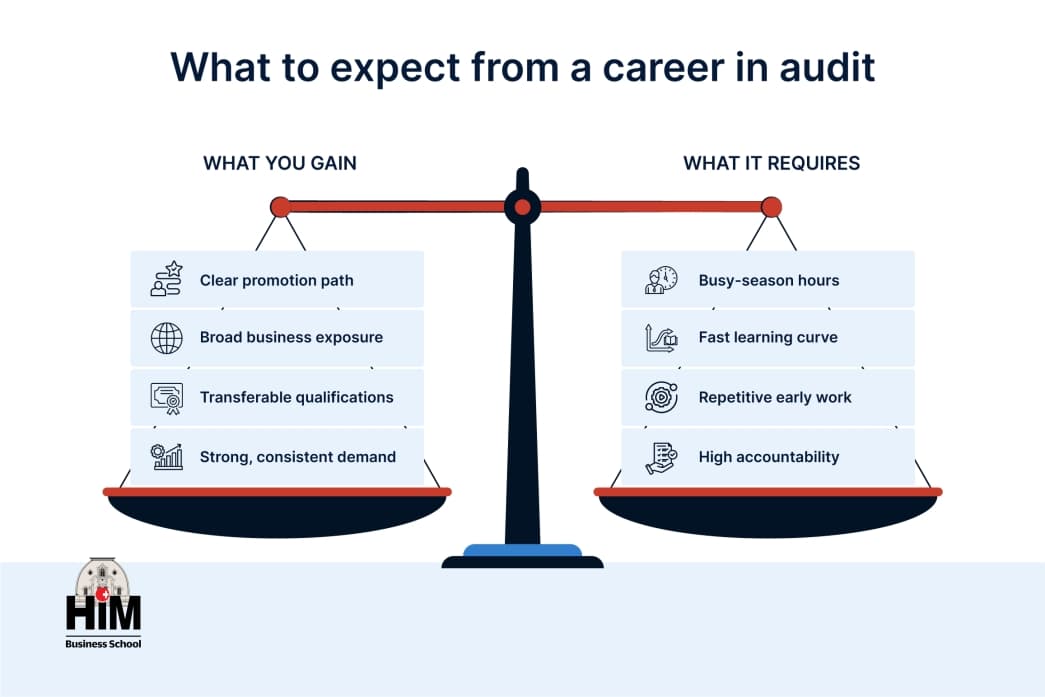
- A structured promotion path with visible steps from junior to partner or chief audit executive.
- Exposure to how dozens of businesses actually operate, which few other entry-level roles offer.
- Qualifications and experience that transfer across borders and industries.
- Consistent demand, since listed companies in most major markets are legally required to have their accounts audited.
However, people also find certain aspects hard, especially the following:
- Busy-season hours, particularly at large firms during reporting periods.
- A steep first-year learning curve, with high technical expectations from the outset.
- Repetitive testing work early on, before the judgment-heavy tasks arrive.
- High accountability, since errors carry consequences for clients and for the firm.
The intensity of the first years is what buys the training and the exit options, which is why many auditors leave with strong offers in hand rather than leaving discouraged.
Is an audit career right for you?
The work suits people who like structured problem solving, can hold concentration across detailed testing, and are comfortable defending a conclusion to someone who disagrees with it. If you enjoy understanding how a business actually runs, audit gives you that view earlier than most roles.
People who want constant variety, dislike documentation, or need quick visible outcomes tend to find the first years frustrating. Much of the value of an audit shows up in what doesn't go wrong afterward.
Auditors who move on tend to go into financial analysis, controlling, risk, consulting, or finance leadership. A move into the work of a financial analyst is among the most common, because the analytical groundwork is already there.
Build the business foundation an audit career runs on
An auditor is the independent professional who confirms that a company's numbers tell the truth, and the route into the work rewards structured preparation more than raw talent. Knowing which degree, which experience, and which qualification comes when is most of the battle.
Our three-year BBA gives you that starting point, with a Finance major and three paid global internships that add 1.5 years of experience to your CV before graduation. We keep the curriculum matched to hiring demand through our World Readiness Index, which is part of what Be World Ready means in practice.
Frequently asked questions
Can you become an auditor without an accounting degree?
In many markets, yes. The ACCA accepts entrants from any degree subject, and graduates of other disciplines simply sit more of the exams, since exemptions depend on what you studied.
How long does it take to qualify as an auditor in Europe?
Candidates who study while working usually reach chartered or ACCA membership three to four years after starting a graduate role, because the exams and the supervised experience run in parallel.
Do auditors travel for work?
External auditors often work at client sites, and group audits of multinationals can mean weeks at overseas subsidiaries. Internal auditors travel according to how spread out their organization's sites are.
Is the CPA or the ACCA better recognized internationally?
They serve different markets. The CPA is the license required for US public company work, while the ACCA is built around IFRS and is held in a wide range of countries, so the better choice depends on where you intend to practice.
Experience a business school with a difference! HIM teaches a customer centric model of business, unique among business schools.